
The Ultimate Guide to Professional Development

As a career coach and trainer, I regularly encounter people who are brand new to the world of professional development. If that’s you, WELCOME! I know it can feel both exciting and overwhelming. My goal in developing this guide is to simplify this vast new world and help you find exactly what you need for your own professional development journey.
This guide explains everything you need to know about professional development—what it is, why it matters, how to find the right professional development opportunities for you and how to get the most out of your activities. This page is improved frequently to ensure you always have the most up-to-date information.
Defining Professional Development
Professional development is the process of developing yourself as a professional. It is an ongoing activity that supports your professional growth throughout your career journey. While it always involves learning, there are many different ways to engage in professional development and many different types of activities that appeal to different types of professionals.
The Benefits of Professional Development
Professional development activities are both personally and professionally rewarding. You can leverage your expanded skills, knowledge and abilities to:
Earn Promotions and Other Opportunities
Whether you’re interested in advancing your role within your current organization or elsewhere, professional development helps make you a more competitive job candidate. Being actively engaged in professional development shows that you’re invested in your career and not complacent; you’re willing to commit the time, energy, and other resources required to grow your capabilities.
Advocate for Raises
While it’s never a guarantee, professional development activities will help bolster your request for more pay. After all, pay raises are both a reward for past performance and an incentive based on potential—the expected value you will be able to create for the organization in the future. Professional development helps to expand your skills, knowledge, and abilities, all of which ultimately expand your potential.
Advocate for Raises
While it’s never a guarantee, professional development activities will help bolster your request for more pay. After all, pay raises are both a reward for past performance and an incentive based on potential—the expected value you will be able to create for the organization in the future. Professional development helps to expand your skills, knowledge, and abilities, all of which ultimately expand your potential.
Additional Reading: How Long is Normal to Go Without a Raise?
Grow Your Role & Responsibilities
Even if you’re not necessarily ready to advance your career in the form of a promotion, you may still want to progress in your role. (Advancement and progression are two different but equally important aspects of career growth.) Progression involves expanding aspects of your role, taking on new and different responsibilities to leverage and develop new skills. When you engage in professional development activities, you are naturally well-positioned to take on this kind of growth. Plus, you will gain more clarity regarding your own areas of interest, thus helping you to play a more active role in crafting your own career progression.
Additional Reading: Career Advancement is Not Always an Upward Path
Enhance Professionalism
Engaging in professional development has the somewhat unexpected benefit of enhancing your overall professionalism. This happens naturally and gradually, simply by virtue of surrounding yourself with other professionals and immersing yourself in discussions related to professional topics. You may find that you slowly adopt a more professional communication style and organically use more professional language in your day-to-day interactions.
Increase Fulfillment
Last, but certainly not least, professional development activities can help you feel a greater sense of fulfillment both personally and professionally. Learning is inherently satisfying, and human beings are naturally drawn to activities that mentally stimulate and challenge us. While it’s easy to become complacent at work, professional development activities help to reignite your sense of enthusiasm. They offer new perspectives and new ways of thinking. It’s no exaggeration to say that professional development activities can completely alter the way you feel about your work—not because the work itself has changed, but because YOU have changed.
In short, professional development activities help you maintain a competitive edge in today’s highly competitive workplace.
The Benefits of Professional Development for Organizations
Professional development is not only beneficial for the individual; it also benefits the organization. According to the Association for Talent Development:
Organizations with strong learning cultures have greater employee retention by 30 to 50%, and employees consistently cite access to training and development opportunities as an important factor when deciding to stay or leave a company.
Organizations that offer comprehensive training programs have 218% higher income per employee and 24% higher profit margins. This is generally assumed to be tied to the improved productivity and effectiveness of an employee whose learning and development are supported.
Professional development fosters higher employee engagement by creating a sense of investment in employees’ careers, which leads to increased job satisfaction, motivation, and commitment to the organization. Engaged employees are more likely to contribute more value to the organization.
This research clearly suggests it’s worthwhile for organizations to invest in the development of their people. (This data is also helpful to share when advocating for financial support of your own professional development activities!)
Areas of Professional Development
Professional development is not the same as job-specific training, which focuses on the nuts and bolts (or “how to” information) for completing the day-to-day work of a role. Instead, professional development represents a broader type of learning designed to enhance skills beyond the current job and position the individual for career growth in the future.
Hard skills refer to the technical knowledge and abilities required to do a job. For example, the ability to use specific tools and technologies are hard skills.
Soft skills (sometimes called “people” or “power” skills) refer to the interpersonal and behavioral strategies and techniques that help a person succeed in a role. Soft skills are less quantifiable than hard skills, but equally (and perhaps more) important for long-term career success.
Standout Skills (my own unique terminology) refers to advanced skills that set you apart from your peers and differentiate you in a positive way. They possess 4 distinct characteristics:
- A Mixture of Soft and Hard Skills: They are multidimensional in that they combine several individual skills together. They have both “human” aspects and technological aspects.
- Complex and Nuanced: Standout skills are not “black and white.” They require a deeper level of intellectual investment and more extensive business acumen.
- Benefit from In-Depth Expertise: Standout Skills can’t be acquired in a one-hour training session due to their nature. They require deep, rigorous study and real-world experience.
- Related to High-Impact Business Activities: Standout Skills go beyond the basic, day-to-day job requirements. They allow us to contribute in a meaningful way to strategic, high-impact activities.
Examples of Standout Skills include Project Management, Process Improvement, Problem Solving & Decision Making, and Change Leadership.

Operational Skills: Technically a part of the “soft skills” category, these often overlooked and undervalued skills enable effective functioning within a work environment. They support reliable and consistent execution and quality output. Examples of operational skills include:
- Discipline
- Work Ethic
- Punctuality
- Attention to Detail
- Resourcefulness
- Follow Through
Transferrable Skills refer to competencies that can be applied across various jobs, industries, and roles. Unlike technical skills, which may be specific to a certain job or field, transferrable skills are broadly applicable. They may be learned in one role but applied (in the future) in another. Some common examples of transferrable skills include things like communication, leadership, problem-solving, adaptability, and critical thinking.
Types of Professional Development Activities
There are countless ways to engage in professional development and activities to suit every learning style and career goal. Here are some of the most popular.
Self-Directed Learning
Self-directed learning allows you to take the reins of your professional growth. These activities are flexible, often low-cost, and can be chosen based on your specific interests and goals.
- Podcasts
- Articles: Check out my complete list of blog articles here.
- Books: Check out my bookstore here.
- Educational Videos: Check out my YouTube Channel here.
Online Learning Platforms and Courses
Digital learning has revolutionized professional development, offering access to high-quality content anytime, anywhere.
- Webinars: Sign up to be notified about my FREE webinars here.
- Virtual Training Courses: Explore the Learning Lab here.
- On-Demand Platforms: Check out the Career Success Library here.
In-Person Events
For those who thrive on personal interaction, in-person events provide a rich environment for networking and learning.
- Conferences: Often involve a number of different presenters leading shorter sessions.
- Workshops: Tend to offer more in-depth, hands-on, interactive learning.
- Training Programs: May involve a series of sessions for progressive learning that builds over time.
Counseling, Coaching & Mentorship
Learning from others is one of the most effective ways to develop professionally.
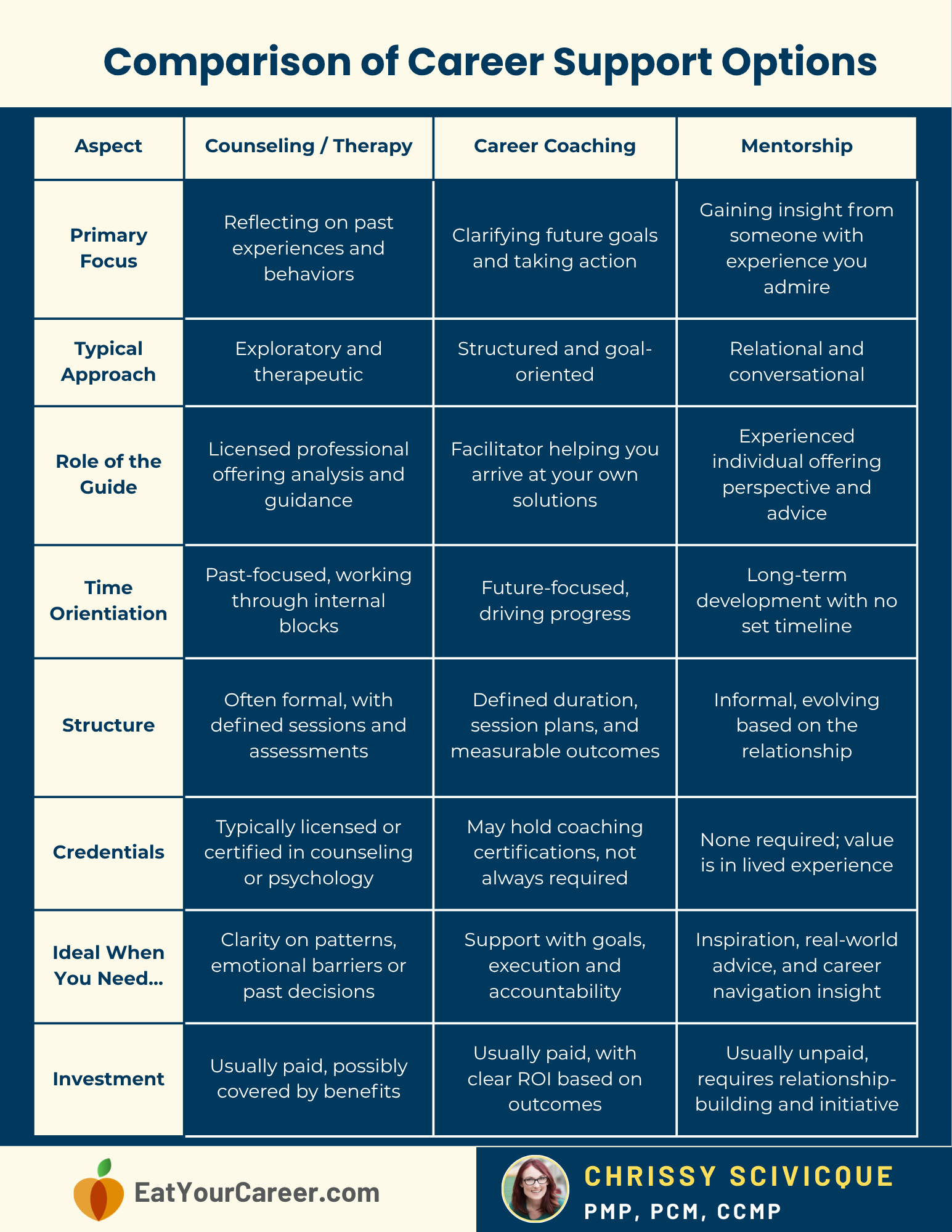
- Career Counseling involves working with a trained practitioner to reflect on past experiences, behaviors, and patterns and gain insights into why certain choices were made and how those patterns might be reshaped moving forward. Counselors usually have formal therapeutic training and are licensed to address personal and emotional challenges.
- Career Coaching is forward-focused and action-oriented. It centers on helping you clarify your future vision and guiding you to arrive at your own conclusions, solutions, and strategies to create a plan to achieve your goals. Coaches may be certified but aren’t necessarily licensed.
- Mentorship is built on a relationship with someone who has walked the path you want to take. Mentors share from experience and offer perspective, advice, and encouragement rooted in a career you admire.
Additional Reading: Finding the Right Support: Counseling vs. Coaching vs. Mentorship
Peer Learning and Networking
Connecting with peers can offer new perspectives and collaborative learning opportunities.
- Professional Associations and Groups: Joining organizations related to your industry and/or professional field expands your network and gives you access to specialized knowledge and resources.
- Mastermind Groups: These small, focused groups of peers provide a space for sharing ideas, brainstorming solutions, and holding each other accountable.
- Resource Sharing: Engaging in resource-sharing sessions, like book clubs or skill-sharing meetups, can broaden your knowledge base.
On-the-Job Development
Learning doesn’t have to happen outside the workplace; there are plenty of ways to grow professionally within your current role.
- Stretch Assignments: Taking on projects or tasks that challenge you can help you hone existing skills and develop new ones.
- Job Shadowing: Observing and learning from colleagues in different roles can expand your understanding of various functions within your organization and help you explore areas of interest for the future.
- Cross-Training: Developing skills in areas outside your primary responsibilities can increase your versatility, visibility and value to the organization.
Advanced Degrees
Pursuing a degree can open doors to higher-level roles. However, the investment of time and financial resources means the payoff may not always justify the costs. Only you can determine if/when an advanced degree is right for you.
Additional Reading: Does Education Still Matter? Yes and No
Additional Reading: How to Get Ahead at Work without a College Degree
Additional Reading: Should I Go Back to School for My Career?
Professional Certification
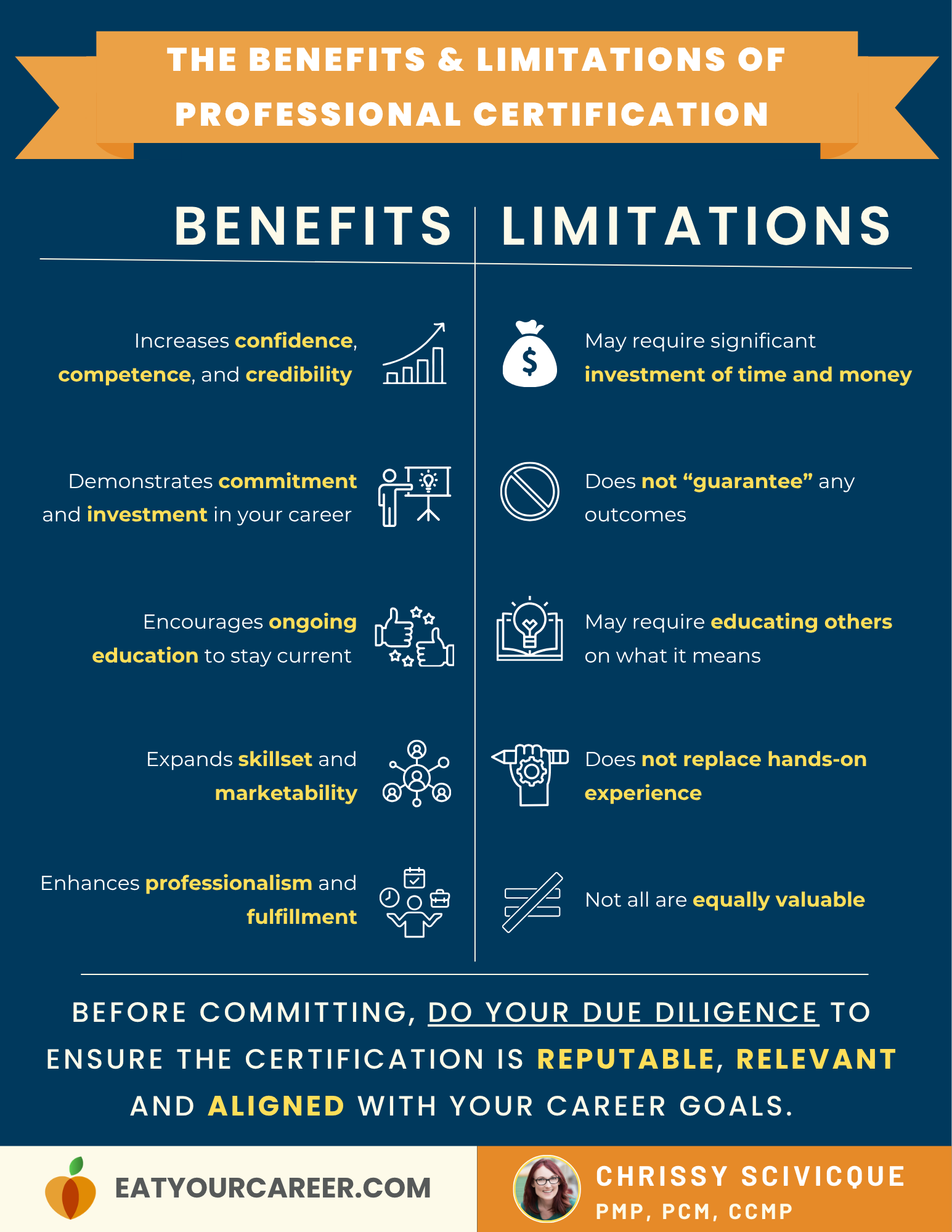
For those seeking a more structured job-specific learning approach without the commitment of a degree, professional certification is an excellent option.
A Certificate Program
A Certificate Program is an education-based achievement. It may be offered by a college, university, or professional training organization and may include a structured series of courses or workshops. The focus is on learning specific skills or knowledge within a defined subject area.
- Completion is based on participation, coursework, and assessments.
- It does not require an external exam or ongoing renewal.
- The certificate signifies completion of education, not professional credentialing.
A Certification Program
A Certification Program is a competency-based professional credential. It may be offered by an independent governing body or association and may be used to validate that an individual has met established standards of knowledge, experience, and competence in a field.
- Earning certification generally requires passing an exam and sometimes meeting experience requirements.
- It must be maintained through continuing education or renewal.
- The certification signifies competence verified by a third party, not just completion of coursework.
Additional Resource: How to Track Continuing Education Units (CEUs) to Maintain Professional Certifications
What's the Right Amount of Professional Development?
General Rule of Thumb
Most career experts (myself included) generally agree that a thriving professional should dedicate 10–20% of their time to development activities. This translates to approximately five weeks (or 200 hours) per year.
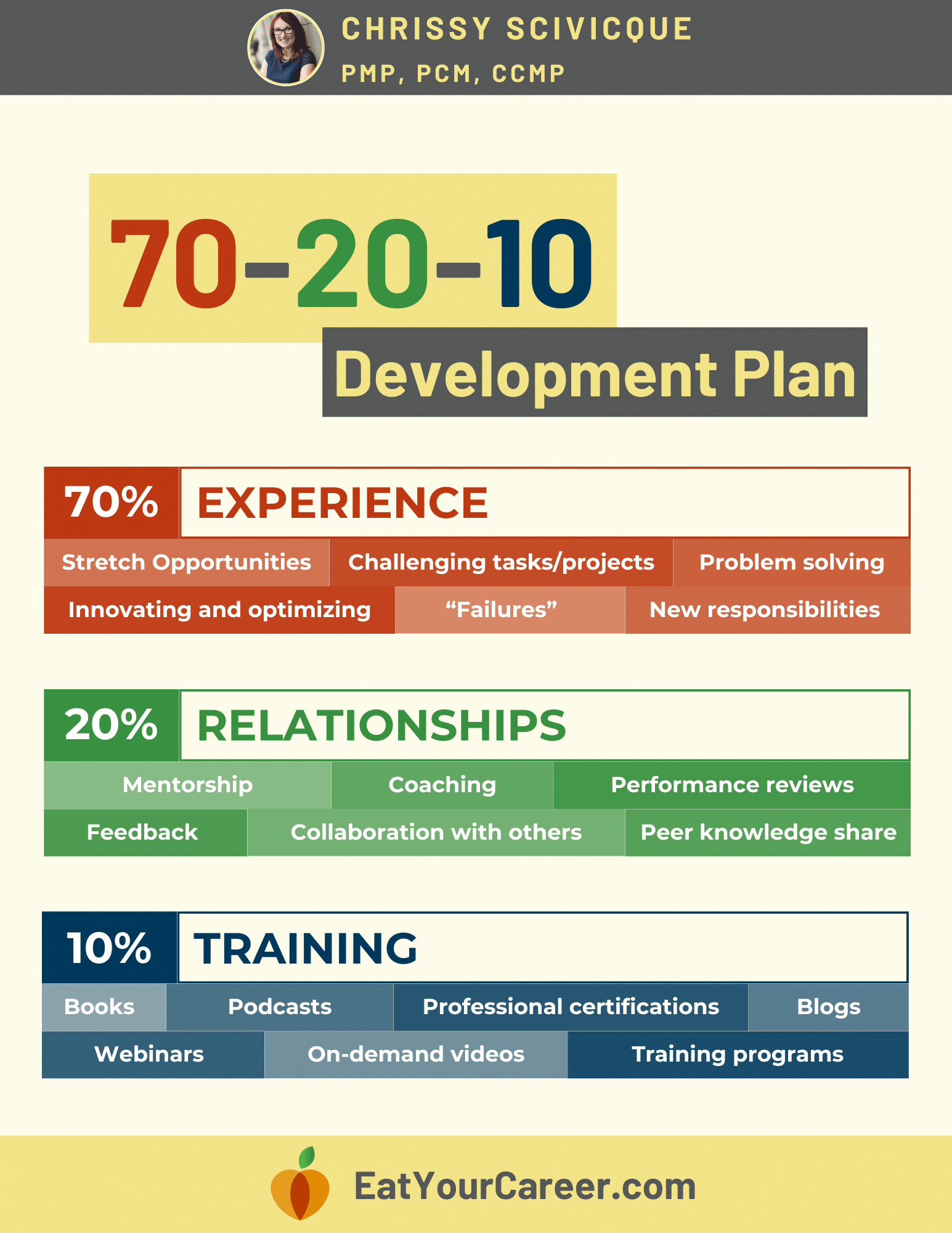
The 70-20-10 model offers an effective way to structure your development. Created by Morgan McCall, Michael Lombardo, and Robert Eichinger—and inspired by the work of psychologist, Kurt Lewin—this model emphasizes the importance of diversifying how you learn. Here’s how it works:
70% On-the-Job
The majority of your development should happen through real-world experience. This includes stretching yourself with challenging projects, solving problems, learning from failures, or stepping into new responsibilities. These hands-on experiences help you build practical skills and knowledge that you can immediately apply.
In the example of 200 hours per year, 70% of that time (or 140 hours) should be spent learning through these kinds of on-the-job experiences.
20% Relationships
Learning through others is a key part of development. This might involve seeking mentorship, receiving feedback from your leaders, participating in peer learning groups, or building your professional network. These activities help you gain insights and exposure to new perspectives and approaches.
In the example of 200 hours per year, 20% of that time (or 40 hours) should be spent learning through your relationships.
10% Training
This more “traditional” form of learning includes in-person or virtual workshops, courses, certifications, or conferences. While structured training makes up a smaller portion of the model, it’s still essential for acquiring foundational knowledge, deepening your skills, mastering new tools, or staying updated on industry trends.
In the example of 200 hours per year, 10% of that time (or 20 hours) should be spent learning through traditional training.
Remember: This is the low-end of the scale. The rule of thumb states 10-20% of your time should be spent on professional development, and 200 hours per year is only 10% for most of us.
To make these numbers feel more manageable, break them down into quarterly or monthly goals. For example, you may want to commit to 5 hours of professional development a quarter, which is less than 2 hours per month. For most people, that feels quite reasonable.
Additional Reading: How to Deal with Professional Development Overload
Planning Your Professional Development
Professional development is most effective when it is intentional. Begin by identifying your long-term career goals. Then, determine the skills, knowledge, and experiences you need to get there.
What is a Professional Development Plan (PDP)?
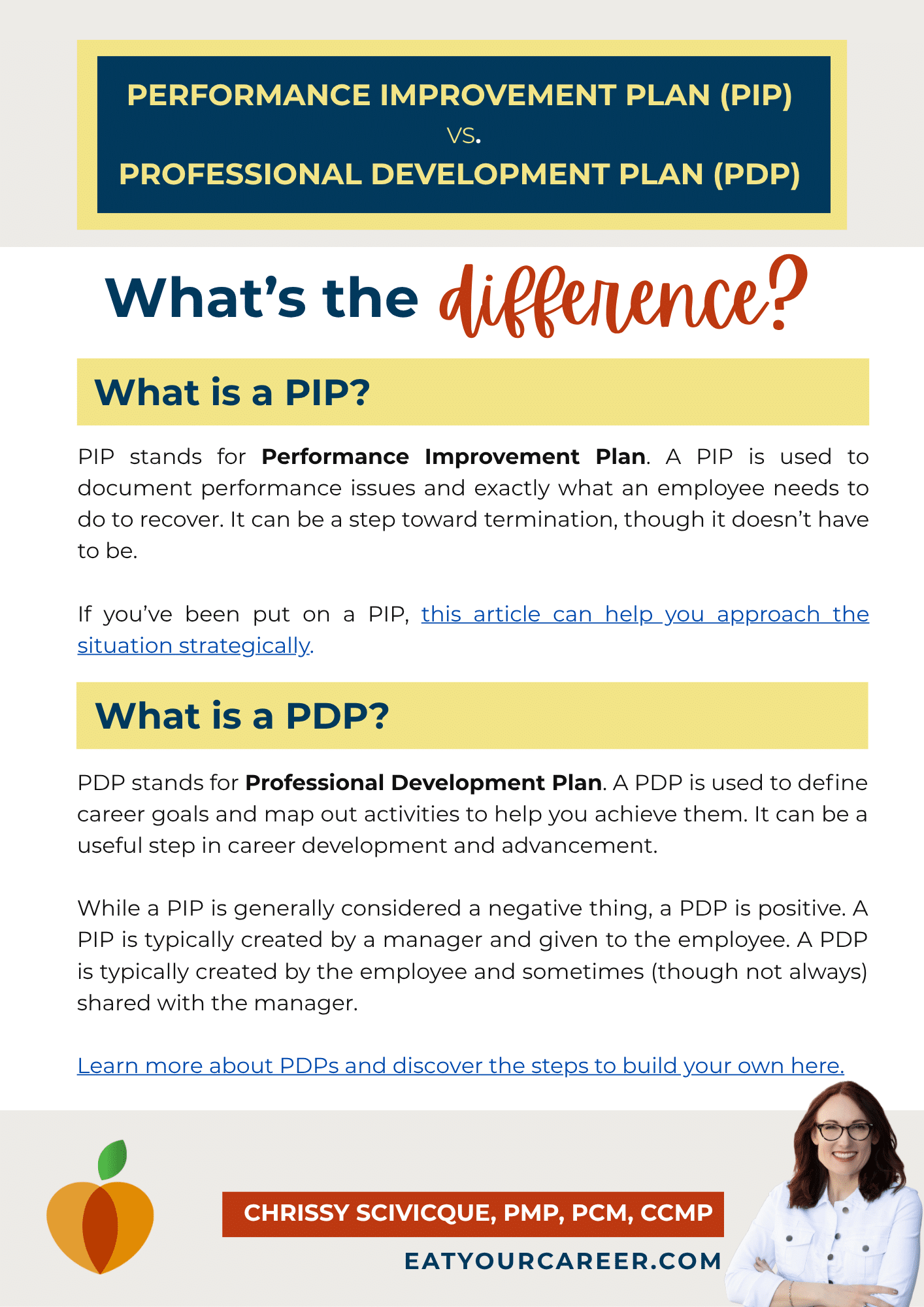
A Professional Development Plan (or PDP) is a written document used to focus, evaluate and prioritize professional development goals and activities.
The Benefits of a PDP
The process of writing a PDP forces you to define what you really want from your career and how you’re going to get it in real terms. The act of writing it down on paper (or typing it) allows you to gain greater clarity. As you go through the process, you will gain a greater understanding of yourself, including your professional strengths and areas for improvement.
What’s Included in a PDP?
Depending on your individual needs, your PDP may include a variety of different elements. However, most PDPs include short and long-term career goals, a list of the professional development areas of focus, and a list of development activities broken down by quarter.
Recommended Reading: How to Write a Professional Development Plan
Additional Resource: Build Your Professional Development Plan Workbook
How are PDP and PIP Different?
A Performance Improvement Plan (or PIP) is generally used to document and address a performance issue. A manager may work with an employee to create a PIP as a means of defining performance concerns and outlining a path for required improvement.
If you have been given a PIP, your employment is potentially on shaky ground. These documents are sometimes used as a “last ditch” effort to reform an employee prior to termination. PIPs should be taken very seriously; they provide a clear mandate for a change in performance and failure to follow the defined requirements may lead to job loss.
Identifying the Right Professional Development Opportunities
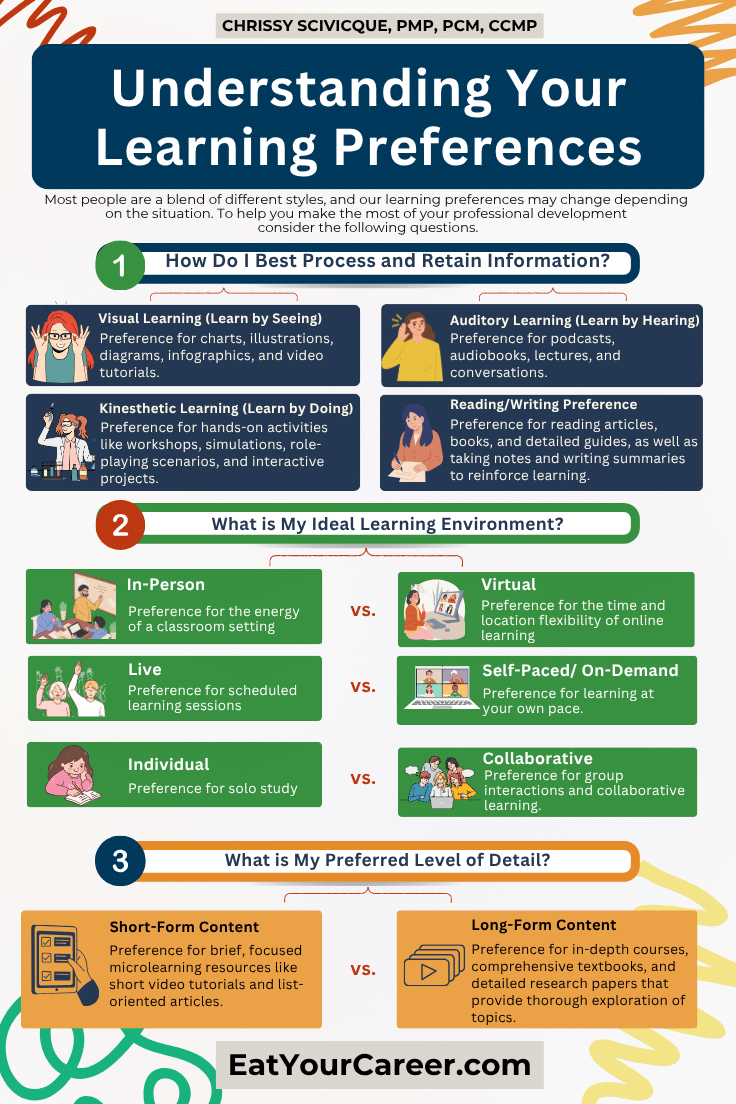
Not every opportunity is the right opportunity. Choose activities that align with your goals, learning preferences, budget, and available time.
Identify trusted thought leaders and learning providers.
Explore training, tuition assistance, and learning resources offered by your organization.
Look for opportunities that help you build both immediate job skills and long-term career capabilities.
Consider your preferred learning style (live, on-demand, virtual, in-person, audio, visual, self-paced, etc.).
Additional Resource: How to Advocate for Professional Development Opportunities at Work
Getting the Most Out of Professional Development Opportunities
The real value of professional development comes from applying what you’ve learned. To maximize your investment:
Set learning goals before you begin.
Take notes and capture key action items.
Apply at least one new idea as quickly as possible.
Share your learning with colleagues to reinforce your understanding.
Table of Contents
- Defining Professional Development
- The Benefits of Professional Development
- Areas of Professional Development
- Types of Professional Development Activities
- Professional Certification
- What’s the Right Amount of Professional Development?
- Planning Your Professional Development Activities
- Identifying the Right Professional Development Opportunities
- Getting the Most Out of Professional Development Activities